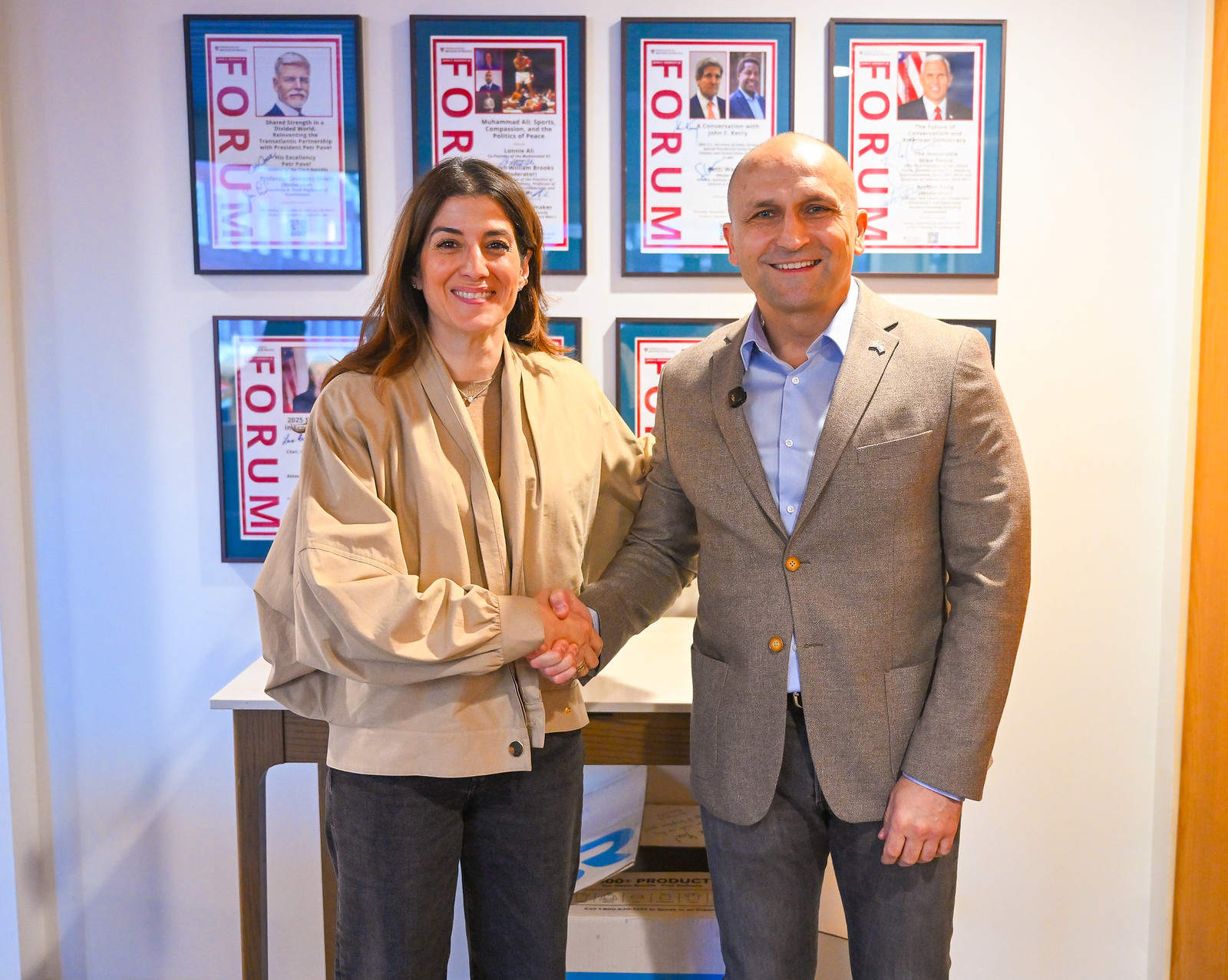
Minister Anušić Discusses the Situation in Southeast Europe at Harvard’s Belfer Center | Photo by: MORH/ F. Klen
Minister Anušić Discusses the Situation in Southeast Europe at Harvard’s Belfer Center
Minister of Defence visits Harvard University’s Institute of Politics at the invitation of former U.S. Ambassador to Croatia Nathalie Rayes
Deputy Prime Minister and Minister of Defence Ivan Anušić yesterday, 4 November 2026, on the first day of his official visit to Harvard University’s Institute of Politics in the United States, met with representatives of the Belfer Center for Science and International Affairs, one of the world’s leading research centres in the fields of international security and defence policy.
Minister Anušić is visiting Harvard University for two days at the invitation of former U.S. Ambassador to the Republic of Croatia Nathalie Rayes. At the Belfer Center, he took part in a seminar on the security situation in Southeast Europe. The discussion with Minister Anušić was moderated by Maureen Page, Associate Director for Evolving International Order at the Belfer Center.
In his remarks, Minister Anušić spoke about the region’s significance and historical context, as well as the current security situation in Southeast Europe. He particularly emphasised Croatia’s role as a factor of stability in the region and the importance of the U.S. presence in the NATO-led KFOR mission in Kosovo. He also stressed that the U.S. presence in Europe has been a key pillar of stability for decades.
The Minister also addressed the need to continue providing assistance to Ukraine in its fight against Russian aggression, noting that Ukraine’s heroic defence has kept the war away from Europe’s borders for almost five years. He also highlighted significant political changes in Southeast and Eastern Europe, including changes of government in the Republic of Serbia and Hungary.
“Southeast Europe has always seen Croatia as a guardian of stability and an advocate of democratic, pro-Western values. Croatia’s role as a member of the European Union and NATO is particularly important today, as we draw on our experience to support our neighbouring countries on their Euro-Atlantic path,” Minister Anušić emphasised.
He stressed that the Republic of Serbia, under the leadership of Aleksandar Vučić, whose ruling party was defeated in the parliamentary elections held on 25 October, had been the greatest source of instability in Southeast Europe. He stated that, in the interests of peace and stability, the new Serbian government, once formed, must distance itself from the Greater Serbian policies pursued by Aleksandar Vučić and, previously, by Slobodan Milošević in the 1990s.
“For Croatia, stability in Southeast Europe is a matter of national interest. In particular, preserving stability and peace in Bosnia and Herzegovina is of crucial importance for the security of our entire neighbourhood,” Minister Anušić stated.