

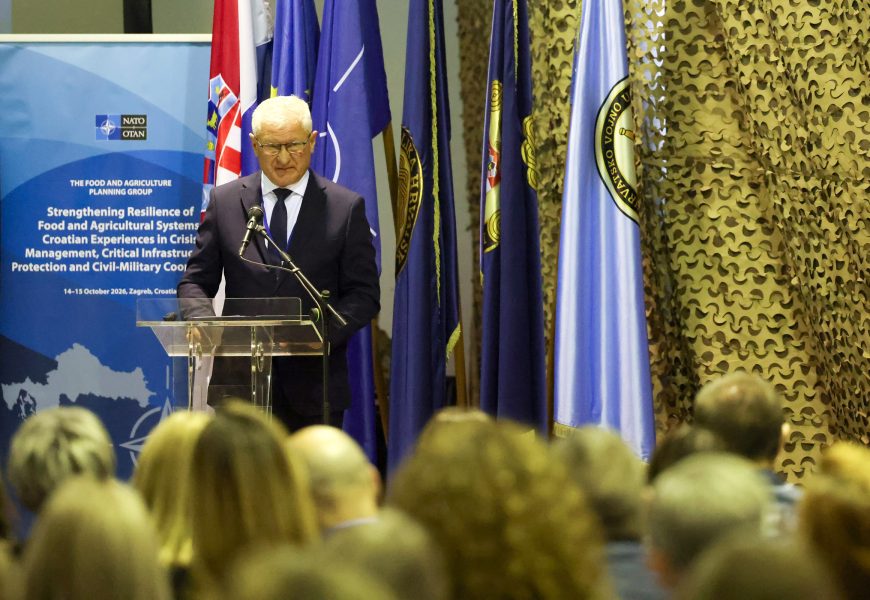
NATO Food and Agriculture Planning Group Seminar at the Croatian Defence Academy | Photo by: MORH/ J. Šeri
NATO Food and Agriculture Planning Group Seminar at the Croatian Defence Academy
“In the defence sector, we regard resilience as an integral part of defence and, more broadly, as an integral part of national security,” State Secretary Hrg emphasised
The NATO Food and Agriculture Planning Group’s (FAPG) Seminar entitled “Strengthening Resilience of Food and Agricultural Systems: Croatian Experiences in Crisis Management, Critical Infrastructure Protection and Civil-Military Cooperation” is being held at the Croatian Defence Academy “Dr. Franjo Tuđman” on Wednesday and Thursday, 14 and 15 October 2026, focusing on the resilience of food and water systems as an essential component of national resilience and security.
The NATO FAPG organised the Seminar, with support from the Ministry of Defence, the Ministry of Agriculture, Forestry and Fisheries, and the Ministry of the Interior of the Republic of Croatia.
At the opening ceremony, State Secretary at the Ministry of Defence Branko Hrg addressed the participants on behalf of Andrej Plenković, Prime Minister of the Republic of Croatia, and Ivan Anušić, Deputy Prime Minister and Minister of Defence. He emphasised the importance of strengthening resilience as one of the key elements of the defence system and national security.
“In the defence sector, we regard resilience as an integral part of defence and, more broadly, as an integral part of national security,” State Secretary Hrg stated.
Speaking about the importance of a comprehensive approach to resilience, he stressed that strengthening it requires coordinated action by the entire Government and as a whole-of-society . He highlighted the important role of the Croatian Armed Forces in protecting the country and providing support to civilian institutions when their capacities are under increased pressure, within their legal remit and available capabilities.
In conclusion, he emphasised that timely action, preventive preparedness and cooperation among all relevant stakeholders are essential for effectively addressing crises.
“Our goal should therefore be clear: to be prepared before a crisis occurs, to act preventively and to work together,” State Secretary Hrg stated.
Prof. Mirna Habuda-Stanić, PhD, from the Faculty of Food Technology Osijek, the seminar coordinator, welcomed the participants on behalf of the Croatian-NATO organising team. She emphasised the importance of hosting this international event in Croatia as an opportunity to present Croatian experiences and examples of good practice in strengthening the resilience of food and agricultural systems, protecting critical infrastructure, and ensuring continuity of food supplies during crises. She underlined that interministerial cooperation, civil-military coordination, and the integration of the defence system with the relevant civilian institutions are essential to strengthening national resilience and security, particularly in the face of contemporary security challenges.
As part of the seminar programme, Nikolina Volf, Acting Director of the Directorate for Defence Policy, delivered a presentation entitled “Strengthening Resilience through Civil-Military Cooperation”, highlighting the importance of cooperation between civilian and military institutions in strengthening resilience.
Ivan Jušić, Director of the Directorate for Human Resources, delivered a presentation entitled “Reintroduction of Basic Military Training – Challenges and Best Practices”, outlining the key challenges and examples of good practice in implementing basic military training.
The seminar programme focuses on the implementation of NATO’s Seven Baseline Requirements for Resilience, with particular emphasis on food security, food supply chain resilience, critical infrastructure protection, hybrid and cyber threats, agroterrorism, and crisis management.
Participants include Stefano Santamato, Head of the Resilience Section at NATO; Lisbeth Muhr, Chair of FAPG; national representatives and civil experts of FAPG; and representatives of relevant Croatian institutions, competent government authorities, academia, and the private sector.


